

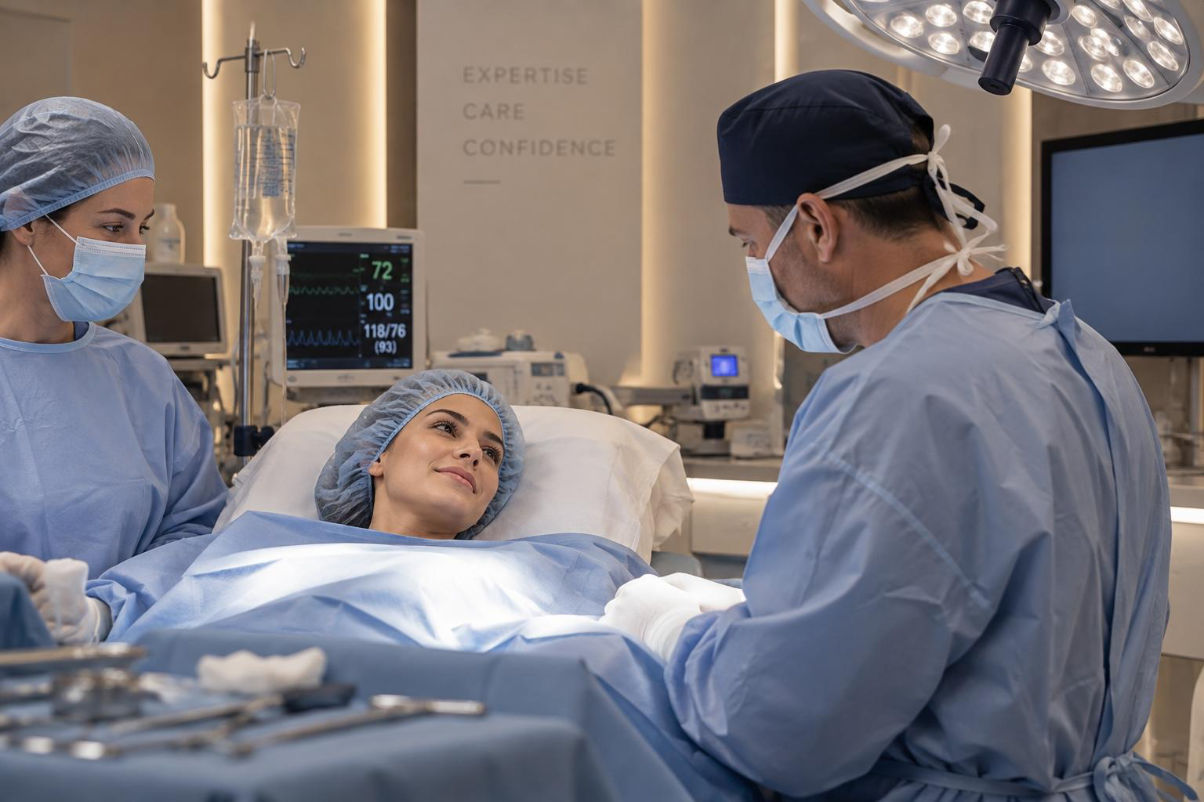
Breast augmentation under local anaesthesia — sometimes promoted as “awake breast augmentation” — has attracted increasing attention.
Technically, operating on an awake patient is not unusual in surgery. There are many procedures where local anaesthesia can be an excellent option. But does that mean breast augmentation should routinely be performed while the patient is awake?
It is possible, but it is not an approach I personally offer for breast augmentation.
Here is why.
Can breast augmentation be performed while you are awake?
Yes. Breast augmentation can, in selected circumstances and depending on the surgical technique, be performed using local anaesthesia, sometimes combined with sedation.
However, the fact that a procedure can be performed under local anaesthesia does not automatically mean it is the most appropriate option for every patient or every operation. With a local anaesthetic technique, the surgeon may not be able to visualise and control the implant pocket in the same way, and the technique can also limit the size and choice of implant that can be used.
Anaesthetic and surgical planning should take into account the procedure being performed, the patient’s health, comfort and preferences, and the surgeon’s technique.
What does “awake surgery” actually mean?
Awake surgery is already well established in certain areas of medicine.
In my reconstructive practice, for example, I perform hand surgery using a technique known as WALANT — Wide Awake Local Anaesthesia No Tourniquet.
For appropriately selected hand procedures, WALANT can be an excellent technique. The patient remains awake while local anaesthetic provides pain control, and a tourniquet is not required.
But the suitability of awake surgery depends heavily on what operation is being performed.
A technique that works extremely well for one type of surgery should not automatically be extrapolated to another.
Why don’t I routinely offer awake breast augmentation?
My main concern is patient comfort.
Breast augmentation involves considerably more than making a small incision and inserting an implant.
The surgeon must create the appropriate pocket for the implant, manipulate the tissues and position the implant accurately. Depending on the surgical plan, this may involve operating above or below the pectoral muscle.
Even if local anaesthetic is being used to control pain, a patient may still experience sensations associated with tissue manipulation, pressure, movement and pushing during surgery.
For that reason, breast augmentation under local anaesthesia is not something I personally offer in my practice.
That is different from saying that awake breast augmentation can never be performed safely or appropriately. Other surgeons may use different techniques and anaesthetic protocols.
My preference reflects how I perform breast augmentation and the experience I want my patients to have during their operation.
Is local anaesthesia safer than general anaesthesia for breast augmentation?
This is an important distinction.
It would be misleading to assume that “awake” automatically means “safer.”
Anaesthesia is only one component of surgical safety.
The appropriate anaesthetic technique depends on multiple factors, including the patient’s medical history, the operation being performed, its anticipated duration and complexity, and the anaesthetic and surgical teams involved.
This decision should therefore be made after an appropriate medical assessment rather than simply choosing whichever option sounds less invasive.
Does being awake make recovery from breast augmentation faster?
Not necessarily.
Recovery from breast augmentation is influenced by much more than the type of anaesthesia used.
Implant position, surgical technique, tissue handling, the patient’s anatomy and individual healing response can all influence postoperative discomfort and recovery.
This is another reason I would be cautious about choosing a surgical approach primarily because it is marketed as allowing the patient to remain awake.
What should you ask if you’re considering awake breast augmentation?
If you are considering breast augmentation under local anaesthesia, useful questions to discuss with your surgeon include:
- Why do you recommend local anaesthesia for me?
- Will sedation also be used?
- How will discomfort and anxiety be managed during surgery?
- What happens if I become uncomfortable during the procedure?
- Does the proposed implant position affect the anaesthetic plan?
- Who will administer and monitor the anaesthesia?
- What are the alternatives?
- What happens if the planned anaesthetic technique needs to be changed during surgery?
The objective should not simply be to remain awake or avoid general anaesthesia. It should be to choose an anaesthetic and surgical plan that is appropriate for you and the operation you are having.
So, should you have breast augmentation while awake?
There isn’t one anaesthetic technique that should be applied to every patient.
I use awake local anaesthetic techniques in areas of my reconstructive practice where I believe they work extremely well. Breast augmentation is different.
For breast implant surgery, given the tissue manipulation involved and the experience this may create for an awake patient, it is not an approach I personally offer.
Ultimately, the decision about anaesthesia should form part of a broader discussion about your anatomy, the planned procedure, implant position, medical history, expectations and individual circumstances.
Considering breast augmentation in Dubai?
If you are considering breast augmentation, the consultation should involve much more than choosing an implant size.
Implant type and position, your anatomy, desired outcome, surgical approach, recovery and anaesthetic options should all be considered together.
To discuss breast augmentation with Dr Charles Bain, Consultant Plastic Surgeon in Dubai, book a consultation through the Mediclinic app or contact the team via WhatsApp: +971 56 970 3561.
This information is intended for general educational purposes and does not replace an individual medical consultation. Suitability for surgery and anaesthesia must be assessed individually.